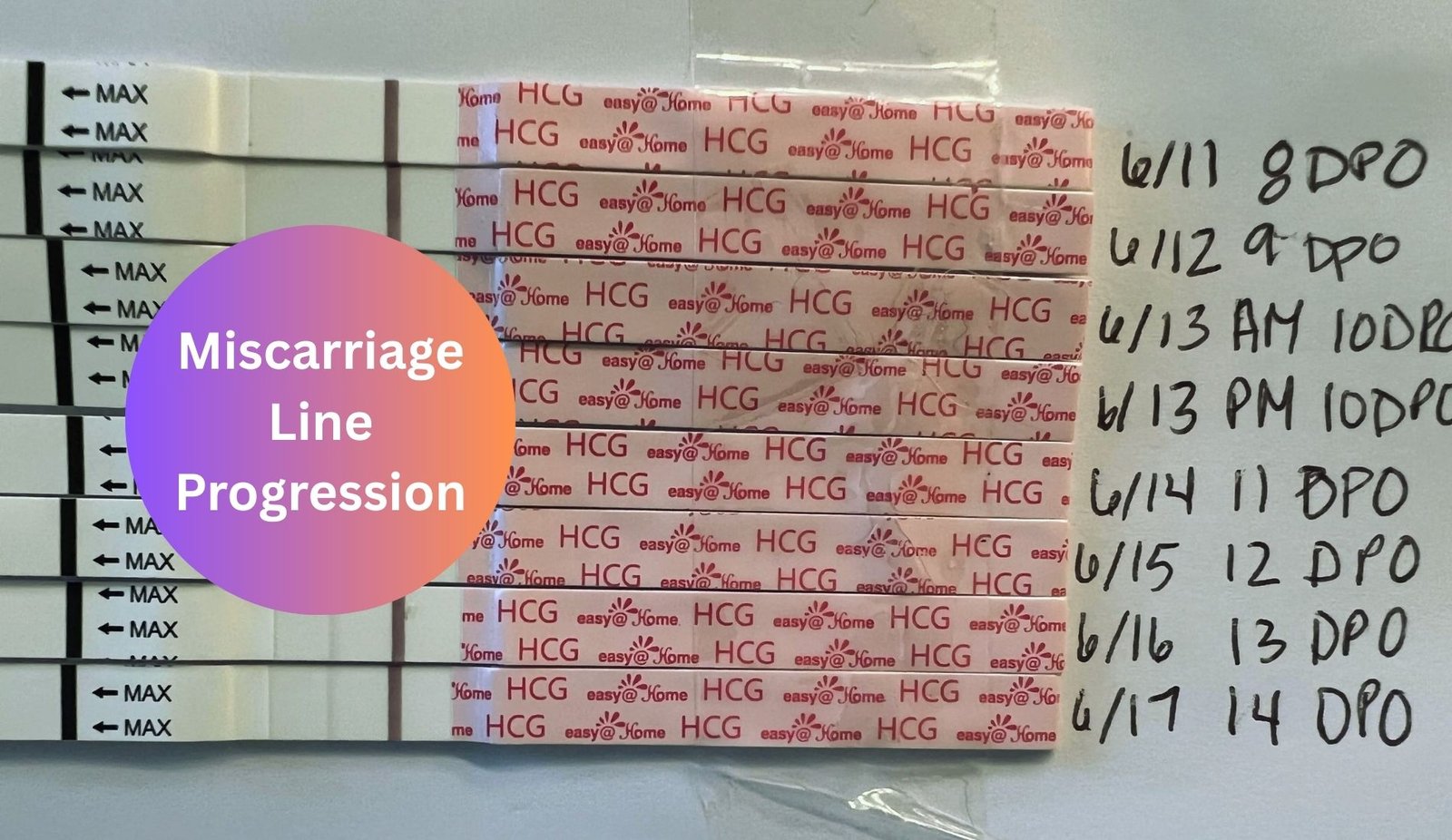
Miscarriage line progression—have you ever wondered why pregnancy test lines get lighter instead of darker? For many women, the faint line on a test can bring confusion, fear, or even heartbreak. Understanding what these changes mean is crucial when dealing with such a sensitive situation.
Miscarriage line progression refers to the gradual fading of pregnancy test lines due to decreasing hCG levels after a loss. Doctors like Dr. Zev Williams, a leading reproductive endocrinologist at Columbia University, explain that falling hormone levels directly impact line visibility. This article will explore what line progression tells you, why it happens, and how to interpret it accurately.
But these scientific explanations are only the beginning of the story. Real experiences, medical insights, and expert-backed guidance make the picture much clearer. So, let’s step into this delicate yet essential topic to better understand miscarriage line progression and what it truly signifies.
Pregnancy Test Progression: What Should It Look Like?
A home pregnancy test works by detecting human chorionic gonadotropin (hCG), the hormone produced after implantation. In a typical early pregnancy, hCG levels roughly double every 48–72 hours. Theoretically, this should make pregnancy test lines appear darker as days progress.
However, in practice, progression is rarely linear. Several factors affect line appearance:
- Urine concentration: Drinking a lot of water before testing can dilute hCG, making lines fainter.
- Different test brands and sensitivities: Not all tests detect hCG at the same threshold. Some register as low as 10 mIU/mL, while others need 25 mIU/mL or higher.
- Time of day: Morning urine usually has the highest hCG concentration.
- Chemical pregnancy or early miscarriage: Sometimes, lines fade or stop darkening if hCG drops.
It’s important to note that even healthy pregnancies may show faint or inconsistent line progression, especially in the first 1–2 weeks after a missed period.
What Your Miscarriage Line Progression Can Tell You?
The term miscarriage line progression is often used to describe the fading or lack of darkening of a pregnancy test line over several days. Women may interpret this as a warning sign of miscarriage. While it can sometimes reflect falling hCG levels after pregnancy loss, it’s not a reliable diagnostic tool.
Here’s what you should know:
- Possible indicator of chemical pregnancy: A very early pregnancy that ends shortly after implantation often causes lines to appear faint and then fade.
- Not always a cause for concern: Some healthy pregnancies show minimal change in line darkness. Relying solely on at-home tests can create unnecessary panic.
- Blood tests are more accurate: A quantitative hCG blood test taken 48 hours apart is the gold standard for determining progression.
- Ultrasound confirmation: By 6–7 weeks of pregnancy, ultrasound becomes a far better method of evaluating viability than home tests.
Myth vs Fact:
- Myth: A faint or stalled line progression always means miscarriage.
- Fact: Line intensity varies widely and is influenced by external factors. Only medical testing can confirm miscarriage.
If you are worried about miscarriage, it’s best to consult a healthcare provider rather than rely solely on home test changes.
What is a Normal Pregnancy Test line Progression?
There is no single definition of a “normal” pregnancy test line progression. Still, most women expect a test line to become darker each day after a missed period. On average:
- Days 10–14 post-ovulation: Very faint to faint lines may appear.
- Days 14–20 post-ovulation: Lines usually darken as hCG levels rise significantly.
- After 5–6 weeks pregnant: Most tests show a strong, dark line.
But again, several exceptions exist:
- Some women have naturally lower hCG that still supports a healthy pregnancy.
- Certain test brands “max out” quickly, meaning the line won’t get darker beyond a certain threshold.
- Hook effect (rare): Extremely high hCG levels can paradoxically cause faint results.
Instead of obsessing over line progression, medical professionals recommend focusing on overall pregnancy symptoms and scheduling proper bloodwork or ultrasounds.
What Does a Faint Line on an Ovulation Test Mean?
While many women use ovulation tests for tracking fertility, faint lines often cause confusion. Unlike pregnancy tests, ovulation tests detect luteinizing hormone (LH), which surges before ovulation.
Here’s what a faint line might indicate:
- Negative test: On ovulation tests, a faint test line typically means LH levels are not high enough to signal ovulation yet. For a test to be positive, the test line should be as dark or darker than the control line.
- Baseline LH levels: Women always have some LH present, which can cause faint lines even outside ovulation windows.
- Approaching ovulation: A gradually darkening line may suggest ovulation is near, but faint lines alone do not confirm fertile timing.
Important distinction:
- Faint pregnancy test lines can still mean pregnancy.
- Faint ovulation test lines generally mean not yet positive.
Understanding this difference helps avoid misinterpretation and frustration when trying to conceive.
Commonly Asked Questions about Early Miscarriage Line Progression (FAQs)
What Is A Positive Beta hCG Test?
A positive beta hCG test detects the pregnancy hormone in blood, confirming pregnancy. This hormone is also what home tests detect as hCG in your urine. Quantitative beta tests measure the exact level.
Should pregnancy test lines be getting darker?
Yes, test lines should darken as hCG levels rise over days. A faint line that doesn’t change may be an evaporation line, not a true positive. Always retest in 48 hours.
Why is my test line not getting darker?
Your test line may not be getting darker due to insufficient exposure time, low contrast settings, or inadequate ink saturation. Additionally, if the doubling time slows, it can affect the overall development process, leading to lighter results.
What is a missed miscarriage?
A missed miscarriage is when an embryo has stopped developing, often around the first pregnancy at 8 weeks, but the body hasn’t yet recognized the loss or expelled the tissue.
How to Prepare for Pregnancy?
Schedule a preconception checkup to review your medical information, start prenatal vitamins, and manage health conditions. Adopt a healthy lifestyle with balanced nutrition and exercise to optimize fertility and support early fetal development.
What’s Normal Progesterone Levels During Pregnancy?
Progesterone rises steadily, from 9-47 ng/mL in the first trimester to up to 300 ng/mL later. Unlike levels of hCG, which peak and fall, progesterone increases throughout gestation to support the pregnancy.
Why is my pregnancy test line getting lighter?
A lighter test line can indicate falling hCG levels, which may suggest a chemical pregnancy or early loss. It could also be due to diluted urine. Always confirm with a blood test and consult your doctor.
What if I get my “period” after a positive pregnancy test?
Bleeding after a positive test may be a chemical pregnancy—an early loss where a fertilized egg stops developing. This causes what seems like a period. It’s common, but consult your doctor to confirm and discuss next steps.
What is the most common chromosomal abnormality causing miscarriage?
The most common cause is aneuploidy, specifically Trisomy 16. Random chromosomal errors prevent normal embryo development, leading to early pregnancy loss. Most occur due to chance, not parental genetics.
Conclusion
The idea of miscarriage line progression has become widespread in fertility forums and social media, but it often causes more anxiety than clarity. Home test line changes are influenced by multiple factors—hydration, brand sensitivity, and timing—and are not a definitive indicator of miscarriage.
For reassurance and accuracy:
- Use tests consistently at the same time of day.
- Avoid comparing tests from different brands.
- Rely on medical follow-ups like quantitative hCG bloodwork or ultrasounds rather than home test progression alone.
While it’s natural to search for certainty during early pregnancy, obsessing over test lines can create unnecessary emotional stress. Trusting professional medical evaluation is always the safest approach.
Related posts
- Ectopic Pregnancy hCG Levels at 5 Weeks (Signs & Monitoring)
- Can UTI Lead to Early Miscarriage or Any Pregnancy Complications?
- Can Transvaginal Ultrasound Cause Miscarriage? (Key Facts)
- Can Missing a Dose of Progesterone Cause Miscarriage IVF?
- Does BV Cause Miscarriage – What Research Says About Risks?