
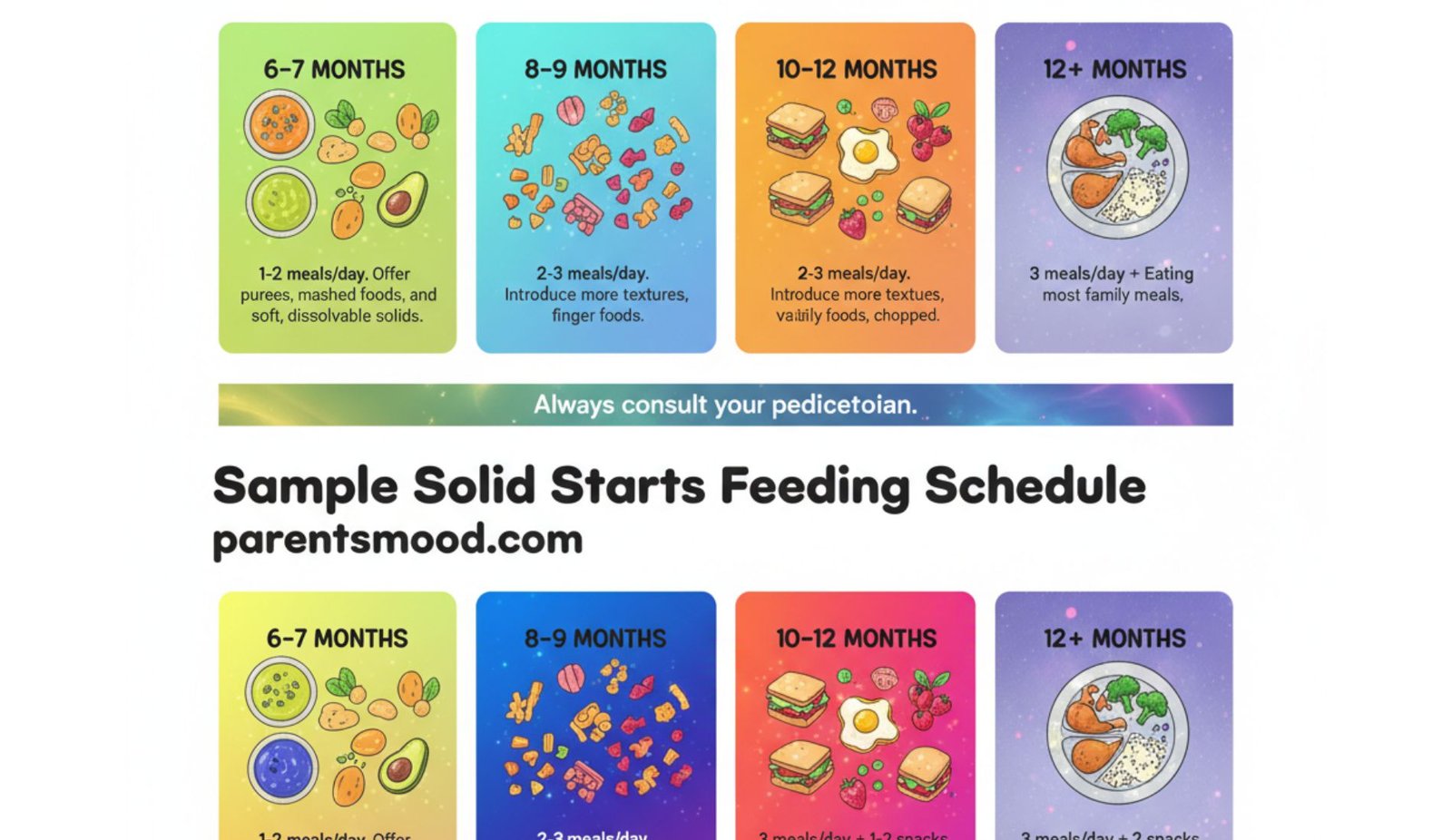
Solid Starts Feeding Schedule gives parents a clear roadmap for introducing real foods with confidence. Many caregivers wonder when to start solids or how often they should offer meals, right? This guide steps in to answer those exact questions while easing the pressure new parents often feel.
This article breaks down this introducing solids schedule into simple steps you can use today. You’ll see how age-based timing, balanced food choices, and consistent routines shape confident eaters, much like the expert guidance shared by Solid Starts founder Jenny Best. Each section gives you practical examples so you can understand the exact progression without confusion.
But this feeding solids schedule doesn’t stop with a few quick pointers. You’ll uncover smart strategies, helpful visuals, and expert-backed tips that make mealtimes smoother. So, if you’re ready to build a confident foundation for your baby’s eating journey, let’s explore the sample feeding guide together.
Solid Starts Feeding Schedule (Month-by-Month)
This introducing solids schedule assumes a typical start of complementary foods around 6 months of age, in line with recommendations from the American Academy of Pediatrics and the World Health Organization. The focus shifts gradually from exploration to caloric contribution, while breast milk or formula remains the primary nutrition source until 12 months.
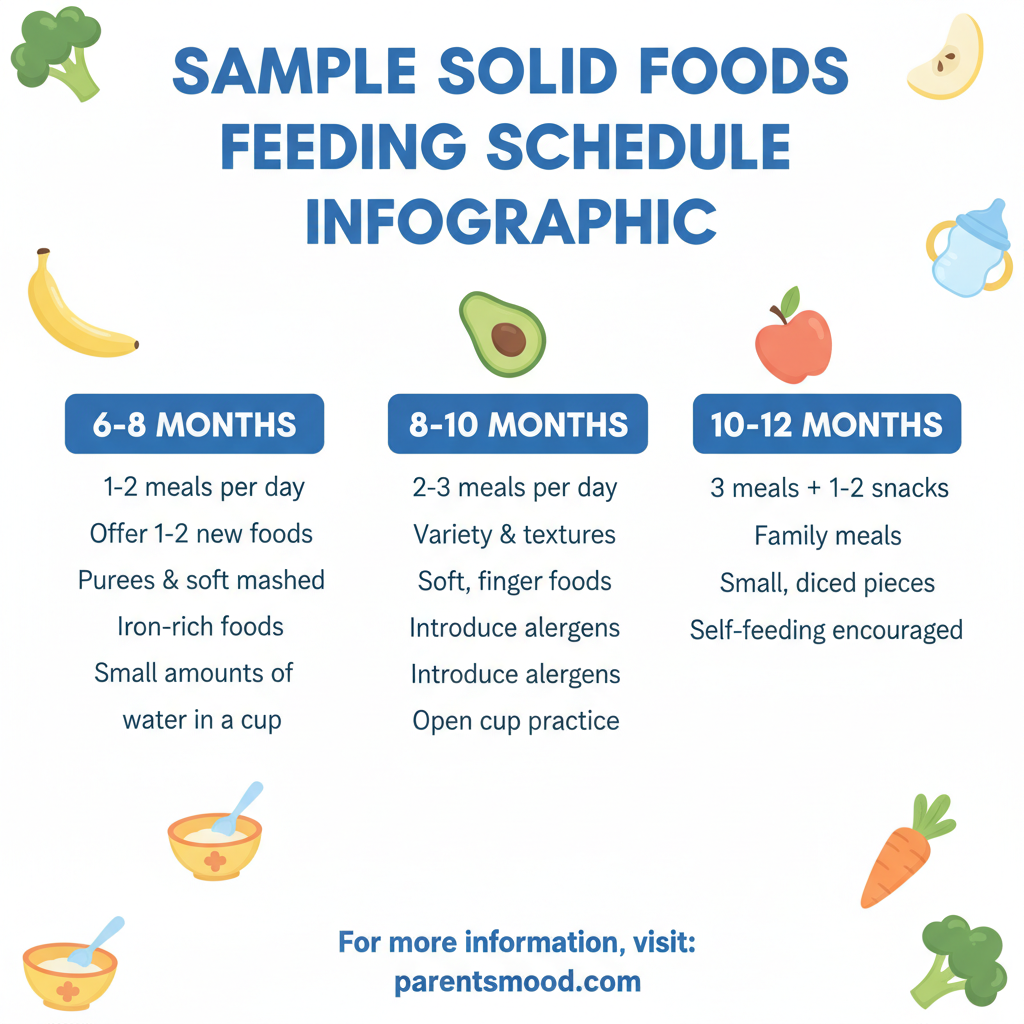
Remember: If your baby is happy eats 3–4 solid meals a day, takes the recommended formula or breastmilk, and has regular wet diapers and bowel movements, this routine is fine.
3 to 5 Months Old On-Demand Breastfeeding
Solids Introduction: Not yet. During this period, the feeding schedule is exclusively liquid. The cornerstone of nutrition is on-demand feeding with breast milk or infant formula.
- Schedule: There is no set schedule. Feed your baby whenever they show early hunger cues: rooting, sucking on hands, increased alertness, or fussing. Crying is a late cue.
- Frequency: Typically 8-12 feedings in 24 hours for breastfed infants, and 6-8 feedings for formula-fed infants, but this varies widely.
- Goal: To support rapid growth and establish a robust milk supply. This on-demand pattern respects the baby’s innate hunger and fullness signals, laying the groundwork for healthy self-regulation. Do not rush to introduce solids during this window; the digestive system and motor skills are still maturing.
6 Month Old Feeding Schedule with Solids and Formula
Solids Introduction: Beginning. At around 6 months, when signs of readiness are clear (sitting with minimal support, good head control, loss of tongue-thrust reflex, interest in food), you can introduce complementary foods. The first month is about exploration, not consumption.
Sample Daily Rhythm:
- Upon Wake-Up: Breast milk or formula feed.
- Mid-Morning (e.g., after first nap): Offer 1-2 tsp of a first food. Ideal options: iron-fortified single-grain cereal, thin avocado puree, or sweet potato puree. Follow with a breast milk or formula top-off if baby is interested.
- Lunchtime: Breast milk or formula feed.
- Afternoon: Breast milk or formula feed.
- Late Afternoon / Early Evening: Optionally, a second “solid” tasting session, again just 1-2 tsp of a food. Follow with a milk feed.
- Bedtime & Night: Breast milk or formula feeds on demand.
Key Principle: “Food before one is just for fun.” Milk feeds remain primary. Solids are offered once, maybe twice daily, always after a milk feeding to ensure nutritional needs are met first.
6 to 7 Months Old Feeding Schedule
Solids Introduction: Expanding. As swallowing improves and interest grows, you can increase the variety and slightly increase the quantity. This is the time to systematically introduce common allergens (one at a time, in small amounts, over 3 days) like peanut butter (thinned), yogurt, and egg.
Sample Daily Rhythm:
- Upon Wake-Up: Breast milk or formula feed.
- Mid-Morning: Solid Meal 1: Offer 2-4 tablespoons of puree or very soft, mashable food. Could include a vegetable and a fruit. Follow with a milk top-off.
- Lunchtime: Breast milk or formula feed.
- Mid-Afternoon: Breast milk or formula feed.
- Early Dinner (e.g., 5 PM): Solid Meal 2: Offer another 2-4 tablespoons of a different food. Could include an iron-rich source like pureed meat, lentils, or fortified cereal.
- Bedtime & Night: Breast milk or formula feeds on demand.
7 Month Old Feeding Schedule with Solids and Formula
Solids Introduction: Consistency & Texture. Many babies at this age are ready for slightly thicker purees and soft, gummable finger foods in safe shapes (large spear or stick they can palm). Self-feeding exploration increases.
Sample Daily Rhythm:
- Upon Wake-Up: Breast milk or formula feed.
- Breakfast (30-60 min later): Solid Meal 1: 3-5 tablespoons of food. Examples: full-fat yogurt with mashed banana, or oatmeal with peanut butter.
- Mid-Morning Nap.
- After Nap: Breast milk or formula feed.
- Lunch: Solid Meal 2: 3-5 tablespoons of food. Examples: flaked salmon, mashed avocado on a spear of toast, soft-cooked carrot sticks.
- Mid-Afternoon: Breast milk or formula feed.
- Dinner (with family if possible): Solid Meal 3: 3-5 tablespoons of food. Examples: beef or lentil Bolognese sauce, soft-cooked broccoli florets, pasta shells.
- Bedtime: Breast milk or formula feed.
- Night: Feeds as needed, though many begin to drop night feeds.
8 to 9 Months Old Feeding Routines – 8 to 9 months of age
Solids Introduction: Becoming a calorie source. With the development of the pincer grasp, babies can pick up smaller pieces of soft food. Meals become more substantial, and the ratio of solids to milk begins to slowly shift.
Sample Daily Starting Solids schedule:
- 7:00 AM – Wake-Up: Breast milk or formula feed.
- 8:00 AM – Breakfast: Substantial solid meal. May include scrambled eggs, oatmeal, or a pouch/puree alongside finger foods.
- 9:30 AM – Morning Nap.
- 11:00 AM: Breast milk or formula feed (may become a smaller “snack” feed).
- 12:00 PM – Lunch: Substantial solid meal with protein, veg, and a healthy fat.
- 1:30 PM – Afternoon Nap.
- 3:00 PM: Breast milk or formula feed.
- 5:30 PM – Dinner: Substantial solid meal, eating what the family eats (modified for salt/sugar).
- 7:00 PM – Bedtime: Breast milk or formula feed.
Milk feeds are now structured around naps and meals, totaling about 24-32 oz of formula or 5-8 breastfeeding sessions.
10 to 11 Months Old On-Demand Breast Milk or Formula
Solids Introduction: Nearing the one-year transition. Babies at this stage often eat three meals and may add one or two scheduled snacks. Milk intake may naturally decrease as solid food intake increases significantly.
Sample Daily Schedule:
- 7:00 AM: Breast milk or formula upon waking.
- 8:00 AM – Breakfast: Full solid meal.
- 10:00 AM – Morning Nap.
- 11:30 AM – Lunch: Full solid meal.
- 1:00 PM: Optional breast milk or formula feed (often skipped or small).
- 2:00 PM – Afternoon Nap.
- 3:30 PM – Afternoon Snack: Nutritious snack like cheese strips, fruit, or teething crackers.
- 5:30 PM – Dinner: Full solid meal with the family.
- 7:00 PM – Bedtime: Breast milk or formula feed.
The focus is on offering a wide variety of family foods. Milk feeds are typically down to 3-4 sessions or 16-24 oz of formula, primarily at wake-up, before naps, and bedtime.
Paced Bottle Feeding Technique:
Whether you are feeding expressed breast milk or infant formula, the paced bottle feeding technique is a critical skill that supports healthy feeding habits and is a cornerstone of any holistic Solid Starts Feeding Schedule philosophy. It mimics the flow and control of breastfeeding, allowing the baby to regulate intake and reduce overfeeding risks.
How to Practice Paced Bottle Feeding:
- Hold Baby Upright: Instead of lying back, position the baby in a semi-upright sitting position in your arms.
- Hold Bottle Horizontally: Keep the bottle parallel to the floor, only tipping it just enough to fill the nipple with milk. This allows the baby to actively draw milk out, rather than having it flow rapidly by gravity.
- Let Baby Pull Nipple In: Encourage the baby to open wide and latch onto the nipple, rather than placing it directly in their mouth.
- Watch for Cues & Pause: After 20-30 seconds of sucking, or when you see a quick succession of swallows, gently tilt the bottle down or lower the baby’s arm to break the seal. This creates a natural pause, allowing the baby to sense fullness.
- Resume When Ready: Offer the bottle again when the baby shows re-engagement cues (rooting, pulling toward bottle). This “pause and resume” pattern helps the baby learn to eat based on internal hunger signals.
Common Questions about Solid Food Baby Feeding Schedules (FAQs)
How much should baby eat at 5 months of age?
A 5-month-old usually follows a milk-focused month feeding schedule, with solids not required yet. Offer solid food only if your pediatrician approves early introducing solid foods. Use a simple sample feeding routine centered on responsive milk feeding during 6 to 24 months.
How do I determine the best baby food portion sizes?
Use your baby’s hunger cues and a flexible month feeding schedule to guide portions. Start small when introducing solid foods, gradually increasing as tolerated. A sample feeding routine for 6 to 24 months focuses on exploration, not volume, while letting appetite lead.
Have you downloaded the Solid Starts app?
The Solid Starts app helps families plan a month feeding schedule, track introducing solid foods, and create a personalized sample feeding routine from 6 to 24 months. It supports safe textures, portion ideas, and confidence when you offer solid food.
Should my 5-month-old baby be eating solid food?
Most babies start introducing solid foods around six months, but some may be ready slightly earlier. Follow readiness signs, not age alone. At five months, a month feeding schedule still centers on milk, and you should offer solid food only with provider guidance.
How much solid food should baby eat at 6 months of age?
At six months, start introducing solid foods with tiny tastes once or twice daily while maintaining milk feeds. Focus on exploration, not quantity. A sample feeding routine within a 6 to 24 months month feeding schedule gradually expands as baby shows interest.
When to let baby control the spoon?
Let your baby begin controlling the spoon when showing readiness—grabbing utensils, sitting well, and showing interest in self-feeding. This supports autonomy during introducing solid foods. Incorporate self-feeding into a month feeding schedule or sample feeding routine for 6 to 24 months.
Conclusion
Crafting the right Solid Starts Feeding Schedule is an exercise in responsive, baby-led flexibility within a sensible framework. This month-by-month guide provides the structure you need to ensure nutritional milestones are met—from first tastes at 6 months to joining family meals by 11 months—while the paced bottle feeding technique ensures milk feeds support healthy habits.
Remember, these templates are a starting point. Your baby’s appetite, growth spurts, and teething will dictate daily variations. The ultimate goal is to cultivate a joyful, pressure-free eating environment where your child learns to explore food, trust their body’s signals, and develop a lifelong positive relationship with eating. Always partner with your pediatrician or a registered dietitian to tailor this journey to your child’s unique needs.
Recommended posts
- Exclusive Feeding Schedule for Newborn Formula (Age-by-Age)
- Top Breastfeeding Challenges for Working Mothers (Solved)
- 3 Negative Effects of Breastfeeding on Mom Rarely Talk About
- Combining Breastfeeding and Starting Solids (Expert Tips)
- Infant Milestones by Month for Tracking Baby Growth & Skills

