When do infants start crawling, and what encourages it to happen naturally? Many parents eagerly watch for this milestone, wondering if their baby develops on track or needs extra support. Does tummy time, floor play, or parental interaction really make a difference?
At what age do infants crawl? Most infants start crawling between 6 and 10 months, according to the American Academy of Pediatrics. Regular tummy time, strong neck and core muscles, and safe floor space actively encourage crawling. Pediatric experts like Dr. Harvey Karp emphasize responsive interaction and freedom of movement as key drivers.
But crawling does not follow a single path, and not all babies move the same way or on the same timeline. Some scoot, some roll, and others skip crawling entirely without developmental issues. So, let’s explore when can infants crawl, and expert-backed insights, practical tips, and science-led guidance that help you confidently support your baby’s early mobility—shall we?
When Do Infants Start Crawling – At What Age Do Babies Crawl?
When do infants begin to crawl? Crawling is a complex motor skill that integrates strength, balance, and coordination. While parents often look for a specific date, the reality is that crawling occurs on a spectrum, making the question “At what age do babies crawl?” one with a range of answers.
The most common window for babies to begin traditional hands-and-knees crawling is between 7 and 10 months of age. However, it’s crucial to understand the broad range of normal development.
Some infants may start as early as 6 months, while others may take their first “crawl” closer to their first birthday, and a small percentage may skip crawling altogether in favor of other locomotion methods like scooting, rolling, or shuffling.
This variation is influenced by several factors:
- Neuromuscular Development: Crawling requires the maturation of complex neural pathways that connect the brain to the muscles.
- Strength: Adequate strength in the neck, shoulders, arms, core, and hips is non-negotiable.
- Temperament: Some babies are more observant and cautious, while others are physically daring and motivated to move.
- Opportunity: Babies need ample, safe “tummy time” and floor play to practice and build the necessary muscles.
Pediatricians emphasize that the sequence of development is often more important than the exact timing. The journey to crawling typically follows a progression: head control during tummy time, followed by pushing up on the arms, rolling over, sitting independently, rocking on hands and knees, and finally, coordinated crawling.
Crawling Styles and Stages of Crawling – Is Your Baby Crawling Normally?
Parents frequently wonder, “Is my baby crawling normally?” The answer is a resounding “yes” to a wide array of styles. Babies are inventive in their mobility, and these variations are typically part of normal development.
Common Crawling Styles:
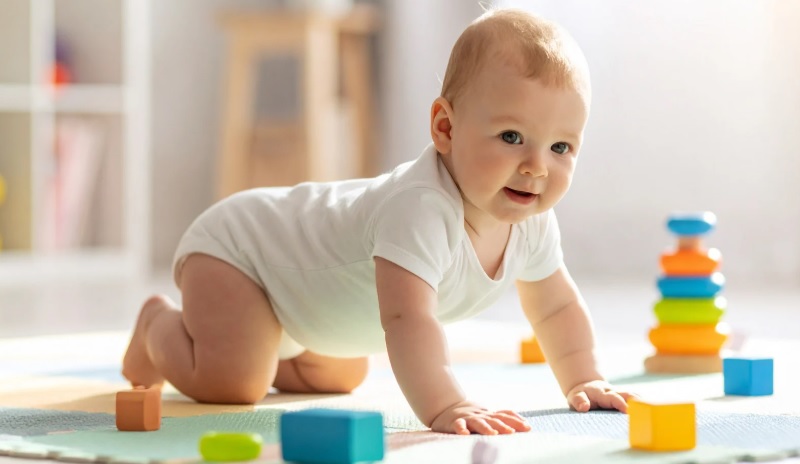
- Classic Crawl: The quintessential cross-crawl. Baby moves on hands and knees, coordinating the opposite arm and leg forward simultaneously.
- Commando Crawl (Belly Crawl): Baby lies flat on their belly and pulls themselves forward using their arms, with legs dragging. This is a fantastic strength-builder.
- Bear Crawl: A more advanced form where baby keeps their elbows and knees straight, walking on hands and feet with their bottom in the air.
- Bottoms Scoot: Baby sits upright and uses their arms to scoot their bottom across the floor.
- Crab Crawl: Baby moves sideways or backward, pushing off with their hands.
- Rolling: Some babies become so efficient at rolling that they use it as a primary method to get from point A to point B.
Stages of Crawling Development:
Crawling doesn’t happen overnight. It unfolds in observable stages:
- The Pre-Crawling Rock: While on hands and knees, baby rocks back and forth. This is a key sign they are building momentum and testing their balance.
- The Lunge: From a rock, they may lunge forward onto their hands, sometimes collapsing onto their tummy before resetting.
- The Army Crawl: As mentioned, this often serves as an interim step, building upper body strength.
- Short-Distance Crawling: Initial attempts are clumsy and cover short distances, often motivated by a nearby toy.
- Efficient, Purposeful Crawling: Finally, baby develops speed, endurance, and the ability to navigate around obstacles and change direction.
If your baby uses any of these methods to become mobile, they are likely developing normally. Consult your pediatrician only if your baby shows a significant lack of interest in moving in any way, seems to favor one side of their body exclusively, or has not shown any progress in mobility by 12 months.
Signs Your Baby Is Ready to Crawl
Before the big launch, your baby will display clear physical and behavioral signals that they’re gearing up for mobility. Recognizing these signs can help you provide the right support at the right time.
- Mastering Tummy Time: They can push up on their arms with a straight back and hold their head up steadily for extended periods.
- Independent Sitting: The ability to sit without support indicates strong core and back muscles, which are essential for crawling.
- Rocking on Hands and Knees: This is the most classic pre-crawling motion. You’ll see them get into the crawl position and rock, building muscle memory and momentum.
- Spinning in a Circle or Moving Backward: These are early experiments with propulsion, often happening before they figure out forward motion.
- Increased “Swimming” Motions: While on their tummy, they may start kicking their legs and moving their arms like they’re swimming.
- Pulling Knees Underneath: During tummy time, you might see them tuck their knees under their body.
- Behavioral Cues: They may show frustration at not being able to reach a desired object, demonstrate heightened curiosity about distant things, or become more active and wiggly during diaper changes.
How to Help Encourage Your Baby to Crawl?
While you can’t—and shouldn’t—force your baby to crawl, you can create an environment that motivates and enables this natural development. Here are the most effective, pediatrician-recommended ways to encourage crawling.
1. Prioritize Tummy Time, from Day One:
This is the single most important exercise for building the neck, shoulder, arm, and core strength needed for crawling. Start with a few minutes several times a day, gradually increasing as baby gets stronger. Get down on the floor with them, use mirrors or high-contrast toys to make it engaging.
2. Create a Motivating Environment:
Place enticing toys just out of reach during floor play. Use toys that move slightly when batted, like a soft ball, to encourage repeated attempts.
3. Minimize Container Time:
Limit the use of bouncers, swings, and walkers. While safe in moderation, excessive time in these devices restricts the free movement and exploration critical for motor development.
4. Give Them the Floor:
The best playground for a pre-crawler is a clean, safe, open floor space. Allow them the freedom to roll, stretch, and experiment with movement.
5. Demonstrate and “Play Crawl”:
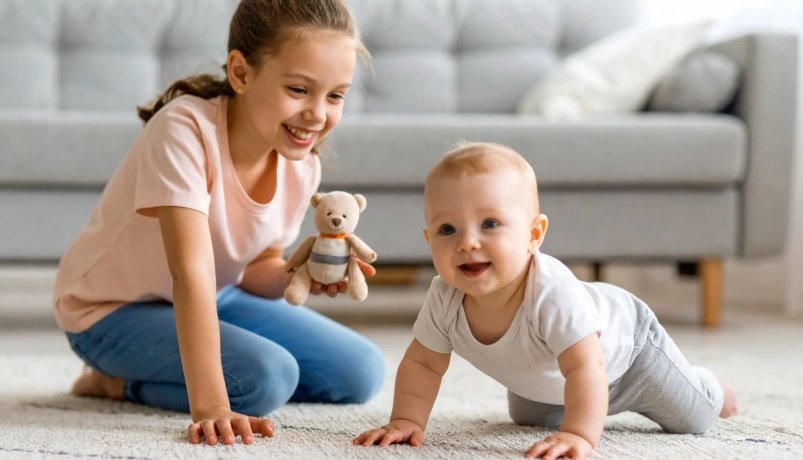
Get down on the floor yourself and crawl around. Let your baby crawl over you. This playful modeling is a powerful incentive.
6. Use Obstacle Courses:
Create simple, soft obstacles using pillows or foam blocks for them to navigate around or (with close supervision) over. This builds problem-solving skills.
7. Strengthen Their Core:
Gently play games that involve sitting balance, like rolling a ball back and forth while they sit, or holding a toy for them to reach for from a seated position.
8. Be Patient and Celebrate Effort:
Applaud any attempt at movement, whether it’s a successful lunge or just a sustained rock. Your positive reinforcement builds their confidence.
How to Keep Your Baby Safe When Crawling?
Once your baby is mobile, your world—and theirs—expands dramatically. Proactive safety is essential. Here’s your essential pre-crawling safety checklist.
Baby-Proofing Essentials:
- Get Down to Their Level: Literally get on your hands and knees and tour every room they will access. Look for sharp corners, loose cords, small objects, and unsecured furniture.
- Secure Furniture: Anchor all bookshelves, dressers, and TVs to the wall to prevent tip-overs.
- Install Safety Gates: Use hardware-mounted gates at the top and bottom of stairs. Pressure-mounted gates can be used for doorways but are not suitable for stairs.
- Cover Electrical Outlets: Use sliding outlet covers that are difficult for little fingers to remove.
- Manage Cords: Tie up blind cords and electrical cords, keeping them out of reach.
- Install Cabinet and Drawer Locks: Especially on cabinets containing cleaning supplies, medications, or sharp objects.
- Cushion Sharp Corners: Use corner guards on coffee tables, fireplace hearths, and other hard edges.
- Create a “Yes” Space: Designate at least one room or large play area that is fully baby-proofed, where they can explore freely without constant “no’s.”
Tips and Tricks for Keeping Your Crawling Baby Safe
Beyond the major baby-proofing, these practical tips will help you manage daily life with your new little explorer.
- Footwear Philosophy: Bare feet are best indoors. They provide optimal sensory feedback and grip on floors, helping with balance and coordination. Save shoes for outdoor or rough-surface protection.
- Dress for the Mission: Put your baby in durable, comfortable clothing that allows full range of motion. Knee pads on pants can be helpful on hard floors.
- Vigilance with Pets: Always supervise interactions. Ensure pet food, water bowls, and litter boxes are in an inaccessible area.
- Bathroom and Kitchen Protocol: Keep bathroom doors closed and toilet lids locked. Use stove knob covers and turn pot handles inward while cooking.
- Choking Hazard Sweep: Regularly scan floors for small items like coins, batteries, magnets, or toy parts. A vacuum with a HEPA filter can help manage dust and allergens they’ll now be closer to.
- Hot and Cold Awareness: Install faucet covers to prevent scalds and use fireplace guards. Keep hot drinks and food well back from table edges.
- Supervision is Non-Negotiable: No amount of baby-proofing replaces attentive adult supervision. Always keep your crawling baby within sight and reach in potentially hazardous environments.
Commonly Asked Questions about Baby Development & Normal Age for Crawling (FAQs)
At what age do babies start crawling?
Normal age for crawling between 7 to 9 months, but it’s a variable developmental milestone. Your baby may begin earlier or later. Observing baby how it’s done helps you see their unique style. Remember, crawling is important for strength and coordination.
How to help your baby learn to crawl?
Help your baby learn by encouraging lots of tummy time. Place toys just out of reach to motivate movement. Showing baby how it’s done by crawling yourself can model the action. This developmental milestone is supported by practice and encouragement.
How Keep my home safe for a baby on the move?
Keep your home safe by securing furniture to walls, covering electrical outlets, and using safety gates. Remove sharp-edged objects and small choking hazards from the floor. As crawling is important for exploration, a clear, padded space allows safe practice of this developmental milestone.
What are the different ways babies crawl?
Babies crawl in different styles: classic hands-and-knees, army crawl (on belly), bear walk (on hands/feet), or bottom scoot. Your baby may use a unique method. Observing baby how it’s done shows this developmental milestone is achieved in various ways.
When do babies start to crawl and may start walking soon?
When can infants crawl? Most babies start to crawl between 7 and 10 months, though every baby is different. Some babies skip crawling and may start walking or scooting. Encourage tummy time, place your baby on the floor often, and watch for signs they are ready to start crawling.
What if my baby isn’t crawling by nine months?
If your baby isn’t crawling by nine months, it may be normal. Babies are different; some may skip crawling or begin crawling later. Speak with your pediatrician if delayed crawling concerns you, and continue encouraging movement, tummy time, and play to build strength and coordination.
How can I encourage my baby to start crawling?
Many babies start rolling and later begin crawling; crawling age for babies varies widely. To encourage your baby to start to crawl, place toys out of reach, praise attempts, and offer supervised floor time daily. Types of crawling and style of crawling differ between infants.
Do some babies skip the crawling stage entirely?
Some babies skip the crawling stage and may crawl before they walk or skip crawling altogether. Every baby is unique; crawling may not be necessary for typical development, though crawling and walking build coordination. Monitor milestones, and consult a professional if you notice significant delays.
What tips can help if my baby doesn’t crawl yet?
Tips to encourage crawling include tummy time, place your baby on the floor, use toys to entice movement, and limit time in baby seats. Make sure your baby uses hands and core. If baby doesn’t crawl by nine months, discuss next steps with a doctor.
What is the normal age for crawling?
The normal age infants crawl is typically between 6 to 12 months, with 9 months being a common average. This major crawling age milestone has a wide range, and some babies may scoot or roll before mastering traditional hands-and-knees crawling.
Conclusion
So, when do infants begin to crawl? The journey to crawling is a remarkable testament to your baby’s growth, blending innate drive with nurtured strength. Remember, the answer to “When do infants start crawling and what encourages it?” is a blend of time, individual development, and supportive opportunity. While the typical range is 7 to 10 months, the true focus should be on the progressive building of skills through ample floor time, playful encouragement, and a focus on strength-building activities like tummy time.
If your baby is exploring movement in their own unique way—be it scooting, rolling, or classic crawling—they are likely on a perfect path for them. Your role is to provide a safe, engaging environment and celebrate each effort along the way.
By following the safety and encouragement strategies outlined here, you’re not just preparing for a milestone; you’re fostering the confidence and curiosity that will propel your child through this stage and many more to come. Embrace the mess, enjoy the chase, and marvel at this incredible leap toward independence.
Recommended posts
- The Complete 6 Month Old Developmental Milestones Checklist
- When Is the First Baby Social Smile? (A Clear Timeline)
- Infant Milestones by Month for Tracking Baby Growth & Skills
- The 30 Month Old Developmental Milestones Checklist and Tips
- Essential Developmental Milestones for Infants 0 12 Months
- A Complete 3 Month Developmental Milestones Guide