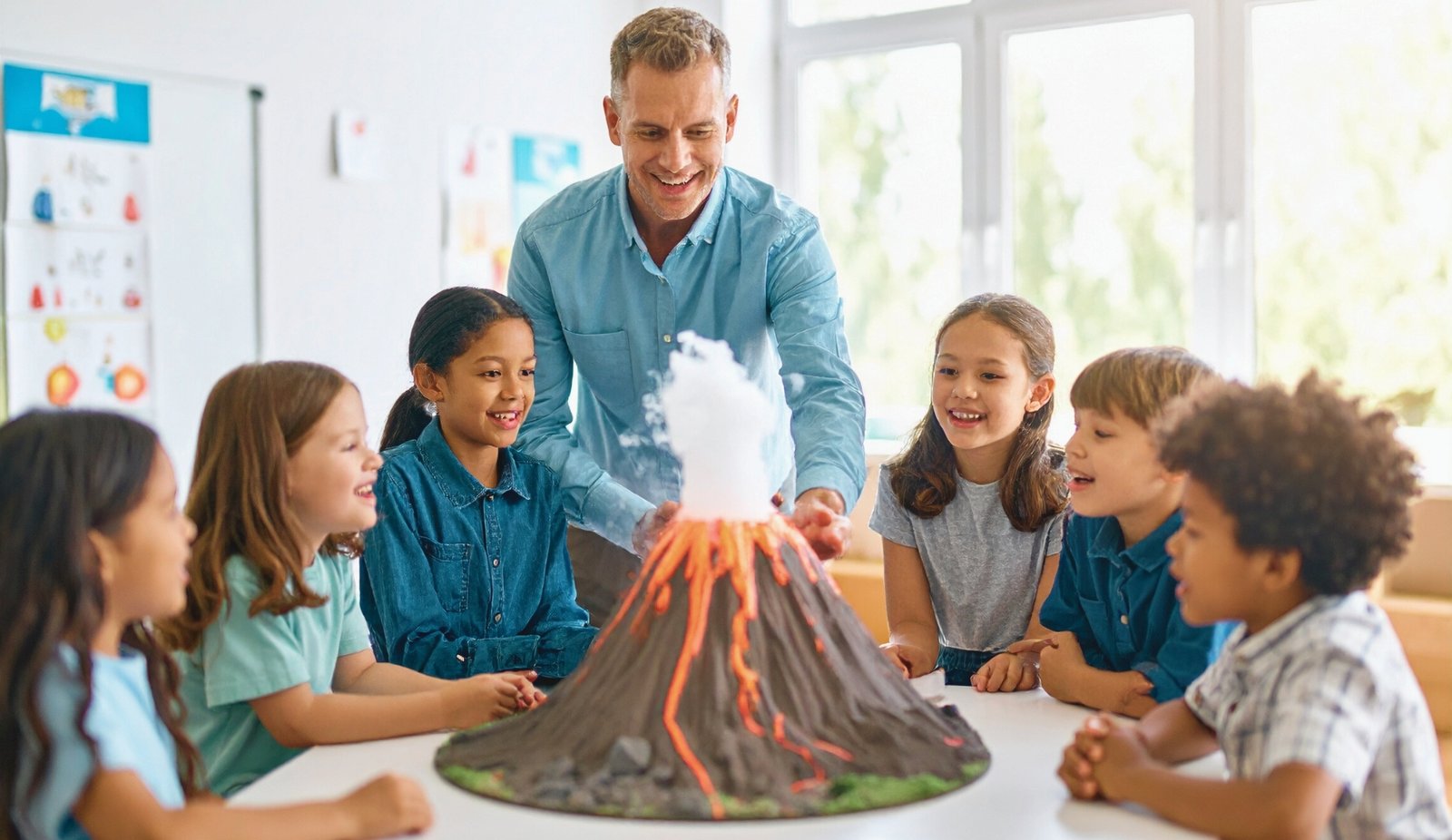
Have you ever seen a volcano erupt and wished you could make one yourself? The Baking Soda Volcano Science Experiment for kids makes that dream come true in the most exciting and educational way. It’s safe, simple, and perfect for young scientists who love hands-on fun. Are you ready to create your own bubbling eruption at home?
This explosive experiment uses baking soda and vinegar to produce a chemical reaction that mimics a real volcanic eruption. The carbon dioxide gas created causes the “lava” to foam and flow just like in nature. In this guide, you’ll learn how to make fun volcano experiments for kids , the materials you’ll need, and step-by-step instructions to make your volcano erupt perfectly every time.
Dr. Emily Grossman, a leading science educator, says that experiments like these “turn curiosity into discovery.” So, let’s get your mini volcano ready and see how science can turn an ordinary kitchen into an exciting volcano lab for kids!
The Science Behind Mini Volcano Experiments:
At the heart of the Baking Soda Volcano Science Experiment is a simple acid-base reaction. When baking soda (sodium bicarbonate) comes into contact with vinegar (acetic acid), the result is a fizzy explosion of carbon dioxide gas (CO₂).
This gas builds pressure inside the volcano model until it bursts out in a foamy eruption, mimicking the behavior of a real volcano—albeit on a much smaller (and safer) scale.
The Chemical Reaction:
NaHCO₃ (sodium bicarbonate) + CH₃COOH (acetic acid) → CO₂ (gas) + H₂O (water) + CH₃COONa (sodium acetate)
This reaction is not only exciting to watch but also provides a fantastic opportunity to teach kids about:
- Chemical reactions
- Gas formation
- Pressure buildup
- Volcanology basics
How to Make an Erupting Volcano Model?
Now for the main event! This is the simple, no-fuss version perfect for a quick and satisfying eruption. If you don’t have time to build a paper mâché model, you can use a simple mound of playdough or even the bottle itself.
Materials Needed:
- Baking soda (4-5 tablespoons)
- Vinegar (1/2 cup)
- Dish soap (optional, for extra foam)
- Red food coloring (for lava effect)
- A small plastic bottle or container
- Cardboard, clay, or papier-mâché (to build the volcano)
- Paint and brushes (for decoration)
- Funnel (for easy pouring)
Step-by-Step Instructions:
- Create the Volcano Structure:
- Place the plastic bottle in the center of a cardboard base.
- Use clay or papier-mâché to sculpt the volcano around the bottle, leaving the opening exposed.
- Let it dry completely before painting.
- Paint the volcano with earthy tones and add creative lava designs.
- Prepare the Eruption Mix:
- Add 2-3 tablespoons of baking soda into the bottle using a funnel.
- Mix a few drops of dish soap and red food coloring with the vinegar in a cup.
- Erupt Your Volcano:
- Pour the vinegar mixture into the bottle.
- Stand back and watch your mini volcano erupt with foamy, red “lava”!
How to Make a Baking Soda Volcano Science Experiment for Kids (Easy DIY)
This version is designed for younger kids and busy parents. It skips the sculpting and focuses on a quick, hands-on experiment with minimal mess.
Quick DIY Instructions:
You’ll Need:
- Small plastic cup or bottle
- Baking soda (2-3 tablespoons)
- Vinegar (1/4 cup)
- Food coloring
- Dish soap (optional)
- Tray or large plate (to contain the mess)
- Measuring spoons and cups
Directions:
- Place the cup in the center of the tray.
- Add baking soda to the cup.
- Mix vinegar with food coloring and dish soap in another cup.
- Pour the vinegar mix into the cup with baking soda.
- Watch the bubbly eruption!
Kid-Friendly Tips:
- Add glitter or dinosaurs for extra fun.
- Use different colors to observe how the lava changes.
- Try using lemon juice instead of vinegar for a variation.
Related Image:
Baking Soda Volcano Science Experiment for Kids
How to Turn It Into a Science Fair Project: Step-by-Step Instructions
To elevate this fun experiment into a full-fledged science fair project, you’ll need to add a scientific method approach and present your findings clearly.
Step 1: Ask a Question
Example: How does the amount of baking soda affect the size of the eruption?
Step 2: Make a Hypothesis
Hypothesis: Increasing the amount of baking soda will result in a larger eruption.
Step 3: Gather Materials
- Baking soda (varying amounts)
- Vinegar (constant amount)
- Food coloring
- Measuring tools
- Stopwatch
- Ruler or measuring tape
- Notebook for observations
Step 4: Conduct the Experiment
- Keep vinegar quantity the same in each trial.
- Change only the amount of baking soda (e.g., 1 tbsp, 2 tbsp, 3 tbsp).
- Measure the height and duration of the eruption each time.
- Record your observations.
Step 5: Analyze Results
- Create a chart or graph to display the relationship between baking soda quantity and eruption size.
- Discuss why the changes occurred.
Step 6: Present the Project
- Use a tri-fold board with labeled sections:
- Title
- Hypothesis
- Materials
- Procedure
- Results (with photos or charts)
- Conclusion
Watch a Science Fair Example:
<div align=”center”>
📺 Related YouTube Video:
[Science Fair Volcano Project](https://www.youtube.com/watch?v=4A8vN3GdYz4)
Volcano Science Fair Project Walkthrough
</div>
Safety Guidelines and Cleanup Tips
While the Science Experiment Lava Lamp is generally safe, here are a few precautions and tips to ensure a smooth and educational experience.
Safety Tips:
- Adult supervision: Always supervise children during the experiment.
- Eye protection: Wear safety goggles if you’re using large quantities.
- Allergies: Check if anyone is sensitive to vinegar or food coloring.
- Ventilation: Perform the experiment in a well-ventilated area.
Cleanup Tips:
- Use a tray or do the experiment outdoors to minimize mess.
- Wipe surfaces with a damp cloth and paper towel.
- Dispose of the mixture down the sink with plenty of water.
- Store unused materials safely out of children’s reach.
Common Questions about How to Make a Volcano Science Experiment (FAQs)
What is a baking soda volcano science experiment?
A volcano vinegar and baking soda experiment is a fun and educational activity that simulates a volcanic eruption using simple ingredients like baking soda and vinegar. When these two ingredients react, they create carbon dioxide bubbles, which push the foam upwards, mimicking the lava flows of real volcanoes.
How do you make a homemade volcano?
To make a homemade volcano, you can use a small container as the crater, place it on a cookie sheet to catch any overflow, and fill it with baking soda. Slowly pour vinegar over the baking soda to initiate the reaction, creating a fizzy eruption that resembles a volcanic explosion.
Can preschoolers participate in the baking soda volcano experiment?
Yes, preschoolers can participate in the baking soda volcano experiment with adult supervision. This hands-on science activity is a great way to introduce them to basic scientific concepts while having fun. Ensure that they understand the process and the safety measures involved.
What materials do I need for the classic baking soda volcano?
For the classic baking soda volcano, you’ll need baking soda, vinegar, a small container for the crater, a cookie sheet to catch spills, and optional food coloring for added visual effect. These household items make it easy to create a fun science experiment at home.
What happens when you mix vinegar and baking soda?
When you mix vinegar and baking soda, a chemical reaction occurs that releases carbon dioxide gas. This rapid release of gas creates bubbles and foam, which simulate the eruption of a volcano. The reaction is both fizzy and visually exciting, making it a popular choice for science experiments.
How can I add a fun twist to the baking soda volcano experiment?
To add a fun twist to the baking soda volcano experiment, consider using different colors of food coloring to create a more visually appealing lava flow. You can also experiment with varying amounts of baking soda and vinegar to see how it affects the height and intensity of the eruption.
Is the baking soda volcano experiment a good STEM activity for elementary-aged children?
Yes, the baking soda volcano experiment is an excellent STEM activity for elementary-aged children. It combines elements of science, technology, engineering, and math by allowing kids to observe chemical reactions, measure ingredients, and predict outcomes, all while engaging in hands-on learning.
What can I learn from the baking soda volcano experiment?
The baking soda volcano experiment teaches several scientific principles, including chemical reactions, the concept of pressure build-up, and the behavior of gases. By participating in this classic baking soda and vinegar volcano experiment, children can better understand how volcanoes on Earth work and the science behind eruptions.
How can I make the volcano eruption last longer?
To make the volcano eruption last longer, you can try adding more baking soda and vinegar in smaller increments. Instead of pouring all the vinegar at once, slowly pour it in, which can help maintain the reaction and create a prolonged fizzy effect. This method allows for a sustained eruption that keeps the excitement going.
Conclusion
The Baking Soda Volcano Science Experiment is more than just a fun activity—it’s a hands-on gateway into the world of chemistry, earth science, and the scientific method. Whether you’re crafting a realistic volcano model or guiding your child through a science fair project, this experiment offers endless opportunities for creativity, learning, and excitement.
From understanding chemical reactions to building DIY volcanoes, and from safety protocols to science fair winning tips, this step-by-step guide equips you with everything you need for a successful and memorable experience. So grab your baking soda and vinegar, and ignite a passion for science—one fizzing eruption at a time!
You might also like
- 15 Easy Science Experiments for Kids That Make Learning Fun
- 100+ Fun Activities for Preschoolers That Encourage Learning
- 15 Cozy Indoor Activities for Families to Enjoy Together