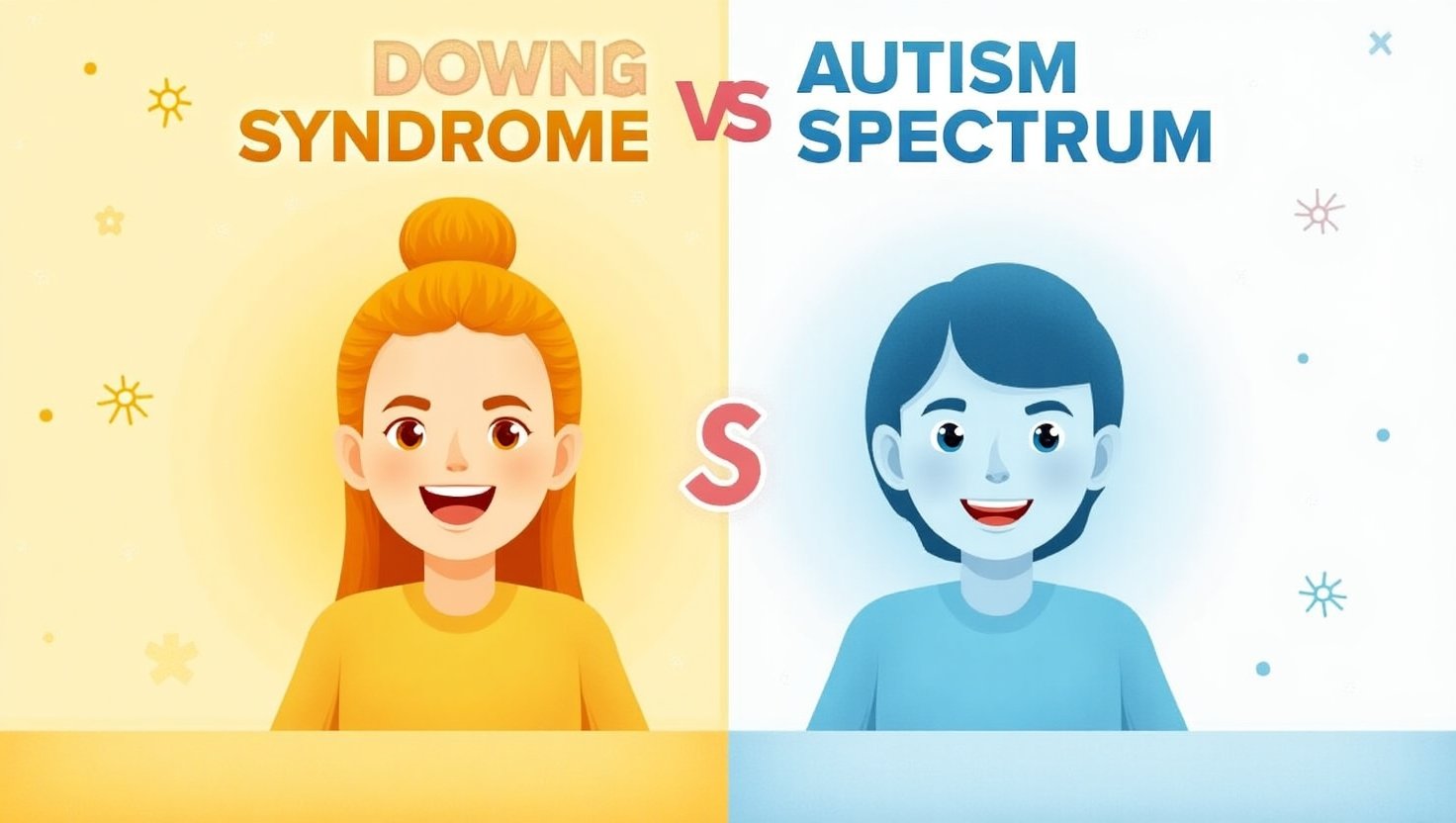
Down Syndrome vs Autism Spectrum Disorder—how do these two conditions differ, and can a person have both? Parents often find the early signs confusing, especially when delays in speech or behavior are involved. So, what sets them apart?
Down Syndrome is a genetic disorder caused by an extra copy of chromosome 21, leading to intellectual disability and distinct physical features. Autism (ASD) is a neurodevelopmental condition that might affects communication, behavior, and social interaction. While Down Syndrome is diagnosed at birth through genetic testing, ASD is typically identified later based on behavioral signs—though both can co-occur in the same individual.
Still unsure which signs point to what? Stay with us as we explore the key differences, overlapping symptoms, and what it means when both conditions are present in one person.
Is Down Syndrome Autism?
Down syndrome and autism are two distinct developmental conditions, though they can sometimes co-occur. Down syndrome is a genetic disorder caused by the presence of an extra chromosome 21, leading to physical characteristics, cognitive delays, and potential health challenges.
Autism Spectrum Disorder (ASD), on the other hand, is a neurodevelopmental condition that affects communication, behavior, and social interaction. While Down syndrome is diagnosed at birth or through prenatal testing, autism is typically identified in early childhood through behavioral signs.
Although individuals with Down syndrome can also have autism, having one does not automatically mean having the other. Understanding the differences is crucial for proper diagnosis, support, and treatment.
Families and caregivers should work closely with medical professionals to ensure tailored interventions. Recognizing that Down syndrome and autism are separate conditions helps promote better awareness, inclusion, and care strategies for those affected by either or both disorders.
Down Syndrome and Autism Spectrum Disorder: A Look at What We Know
Down Syndrome Vs Autism: How to Tell the Difference and Why It Matters? Down Syndrome and Autism Spectrum Disorder are both developmental conditions, but they arise from different underlying causes. Down Syndrome is a genetic condition caused by an extra chromosome 21, while Autism Spectrum Disorder refers to a group of conditions that affect an individual’s social skills, communication, and behavior.
– Down Syndrome
Down Syndrome is typically diagnosed at birth through physical traits and genetic testing. The most common feature of Down Syndrome is the presence of an extra copy of chromosome 21, which affects physical and intellectual development. Individuals with Down Syndrome usually experience mild to moderate intellectual disability, and some may face health challenges like heart defects or respiratory issues. However, many people with Down Syndrome lead happy, productive lives with proper care and support.
– Autism Spectrum Disorder
Autism Spectrum Disorder, on the other hand, is a developmental disorder that affects an individual’s ability to communicate and interact socially. ASD includes a wide range of symptoms and severities, which is why it is called a “spectrum.”
Symptoms may vary from person to person, ranging from mild to severe, and may include repetitive behaviors, sensory sensitivities, and difficulty with social interactions. Unlike Down Syndrome, autism is not caused by a genetic anomaly but is thought to result from a combination of genetic and environmental factors.
What are the Difference Between Autism and Down Syndrome?
While both conditions affect developmental and social aspects of life, there are key differences between Autism and Down Syndrome. These differences range from their causes and genetic factors to their symptoms and diagnostic criteria.
Genetic Factors
The primary difference between Down Syndrome and Autism is genetic. Down Syndrome is caused by a chromosomal anomaly where there is an extra copy of chromosome 21, while Autism is not caused by a single genetic mutation but rather a combination of genetic predispositions and environmental factors.
Cognitive Development
People with Down Syndrome typically experience intellectual disabilities ranging from mild to moderate. They may have delays in speech, learning, and motor development, but these abilities can improve with early intervention and support. In contrast, people with Autism may have intellectual abilities that vary widely. Some may have average or even above-average intelligence, while others may have intellectual disabilities.
Social and Communication Skills
One of the most notable differences is in how individuals with Down Syndrome and Autism interact socially. Individuals with Down Syndrome tend to have more difficulty with speech and language, but they generally enjoy social interaction and form close relationships with family and friends.
On the other hand, individuals with Autism may find it challenging to engage in social interactions and often have difficulty understanding social cues. They may struggle with making eye contact, maintaining conversations, and developing social relationships.
Sensory Sensitivities
Autism often comes with sensory sensitivities. Many individuals with Autism may experience hypersensitivity or hyposensitivity to stimuli such as light, sound, touch, and smell. This is not typically seen in individuals with Down Syndrome, although sensory processing issues can occasionally be present.
Down Syndrome vs Autism Spectrum Disorder (ASD)
The comparison between Down Syndrome and Autism Spectrum Disorder becomes clearer when we examine their impact on behavior, communication, and development.
Here’s a comparison table highlighting the key differences between Down Syndrome and Autism Spectrum Disorder (ASD):
| Feature | Down Syndrome | Autism Spectrum Disorder (ASD) |
|---|---|---|
| Definition | A genetic condition caused by an extra chromosome 21 | A neurodevelopmental disorder affecting behavior and communication |
| Cause | Chromosomal abnormality (Trisomy 21) | Unknown; likely a combination of genetic and environmental factors |
| Diagnosis | Through genetic testing, typically at birth or prenatally | Based on behavioral assessments and developmental evaluations |
| Physical Appearance | Distinct facial features (e.g., almond-shaped eyes, flat face) | No specific physical features |
| Cognitive Functioning | Intellectual disability is common, typically mild to moderate | Wide range; may include intellectual disability or average to above-average intelligence |
| Social Interaction | Generally sociable and friendly | May struggle with social skills, communication, and relationships |
| Speech & Language | Delayed speech development common | May have delayed, absent, or atypical speech and language |
| Motor Skills | Often delayed but typically improve with therapy | May be delayed; motor coordination issues may be present |
| Behavioral Characteristics | Predictable and consistent behavior patterns | Repetitive behaviors, restricted interests, sensory sensitivities |
| Co-occurrence | May co-occur with ASD (dual diagnosis is possible) | May co-occur with genetic syndromes, including Down Syndrome |
| Treatment Approach | Early intervention, speech/occupational therapy, educational support | Behavioral therapy (e.g., ABA), speech/occupational therapy, educational support |
| Life Expectancy | Around 60 years or more with modern healthcare | Normal life expectancy (varies based on co-occurring conditions) |
Communication
People with Down Syndrome typically struggle with speech and language development, and it can take them longer to form words and sentences. However, they usually develop a desire to communicate and can use nonverbal communication methods, such as gestures, to express themselves.
Individuals with Autism, however, may have more profound communication challenges. Some may be nonverbal or have difficulty initiating and sustaining conversations. Others may engage in echolalia, which is the repetition of words or phrases.
Social Interaction
While individuals with Down Syndrome enjoy social interaction, people with Autism may find it difficult. Social skills training can be beneficial for both, but the approach may differ. For individuals with Down Syndrome, therapy often focuses on speech and language development to help them express themselves effectively. For those with Autism, interventions may center around teaching social skills, understanding emotions, and interpreting social cues.
Behavioral Symptoms
Behavioral challenges also differentiate the two. People with Down Syndrome may have challenging behaviors due to frustration, communication difficulties, or physical limitations. These behaviors can often be managed with a structured routine, clear communication, and support from caregivers.
Children and adult with autism may engage in repetitive behaviors, such as hand-flapping or rocking, and may also have a strong preference for routines and rituals. Interventions for Autism focus on helping the individual adapt to changes and reduce anxiety in social situations.
Can a Person with Down Syndrome Also Have Autism?
Yes, it is possible for an individual to have both Down Syndrome and Autism. In fact, some studies suggest that children with down syndrome are more likely to be diagnosed with Autism than the general population. The co-occurrence of Down Syndrome and Autism presents unique challenges for caregivers, teachers, and health professionals.
People with both conditions may exhibit common characteristics of both Down Syndrome and Autism, including intellectual disability, delayed speech, social difficulties, and repetitive behaviors.
It is essential to conduct a comprehensive evaluation to understand the full scope of an individual’s needs. Treatment plans will be more complex, but a combination of therapies for both Down Syndrome and Autism can lead to significant improvements in communication and social skills.
When Down Syndrome and Autism Intersect?
When Down Syndrome and Autism intersect, it can make diagnosis and treatment more complicated. Early intervention is key, as it can help address developmental delays and improve outcomes.
Dual Diagnosis Symptoms
Symptoms that might appear in individuals with both conditions include:
- Significant delays in language and communication.
- Intense social challenges, such as difficulty understanding or responding to social cues.
- Repetitive behaviors, such as lining up objects or hand-flapping.
- Sensory processing difficulties, such as being overly sensitive to certain sounds or textures.
Diagnosis
It can sometimes be difficult to distinguish between the symptoms of Down Syndrome and Autism, as there is overlap. For instance, both conditions can involve communication difficulties and social challenges. Therefore, it is essential for healthcare providers to conduct thorough assessments to provide an accurate diagnosis and determine the appropriate treatment and support strategies.
Supporting Individuals with Autism and Down Syndrome
Support for individuals with both Down Syndrome and Autism needs to be holistic and individualized. A comprehensive support plan should address all aspects of an individual’s life, including:
Early Intervention
Early intervention programs that address speech and language development, social skills, and adaptive behavior are critical for success. These programs should incorporate techniques suitable for both Down Syndrome and Autism.
Therapy Options
Therapies may include speech therapy, occupational therapy, behavioral therapy, and social skills training. These therapies help to improve communication, sensory processing, social interactions, and emotional regulation.
Educational Support
Special education services tailored to the needs of individuals with both Down Syndrome and Autism can provide a structured environment for learning. Individualized Education Programs (IEPs) should be developed to ensure that educational goals are aligned with the individual’s strengths and challenges.
Family and Caregiver Support
Families and caregivers of individuals with both Down Syndrome and Autism need support and resources. Training on how to address behavioral challenges, implement effective communication strategies, and provide emotional support is essential. Community-based programs and support groups can also provide valuable connections and guidance.
Commonly Asked Questions about Autism Vs Down Syndrome (FAQs)
What are some signs that my child with Down syndrome might have ASD?
Key signs include social impairment, repetitive behaviors, and communication delays beyond typical developmental disabilities—seek a diagnosis of autism if these autistic traits appear.
Why pursue an evaluation or formal diagnosis for ASD and Down syndrome?
A diagnosis of autism clarifies needs, as pervasive developmental disorder traits in DS-ASD require tailored support distinct from Down syndrome alone. Early intervention helps.
What are the Differences between Down syndrome and Autism symptoms?
Down syndrome involves intellectual delays; autistic traits (social impairment, rigid routines) suggest pervasive developmental disorder. Distinct conditions, but dual diagnosis is possible.
How common is a dual diagnosis of Down syndrome and autism?
~16% with Down syndrome also meet diagnosis of autism criteria, showing autistic traits atop developmental disabilities—a unique overlap needing specialized care.
What medical conditions are commonly linked to Down syndrome (including DS-ASD)?
DS-ASD combines developmental disabilities with autistic traits. Heart defects, sleep apnea, and pervasive developmental disorder symptoms often co-occur, requiring multidisciplinary care. (30 words)
How does DS-ASD present differently than autism or Down syndrome alone?
DS-ASD blends syndrome without typical social warmth (Downs) with autistic rigidity, creating distinct conditions needing hybrid therapies for impairment in both areas. (30 words)
What are the similarities between autism and Down syndrome?
Both involve developmental disabilities and speech delays, but autistic traits (e.g., sensory issues) in pervasive developmental disorder differ from Downs’ cognitive profile. Distinct conditions often overlap.
Conclusion
In conclusion, Down Syndrome and Autism Spectrum Disorder are two distinct developmental conditions, but they share some overlapping features. While the causes, symptoms, and treatments for each condition differ, both require specialized support and care to help individuals thrive. Understanding the differences between the two conditions is essential for proper diagnosis and intervention. Early diagnosis, intervention, and ongoing support can lead to improved outcomes for individuals with Down Syndrome, Autism, or both. With the right resources, individuals can lead fulfilling lives and contribute to their communities in meaningful ways.
This comparison of Down Syndrome vs Autism Spectrum Disorder aims to clarify common misconceptions, highlight key distinctions, and emphasize the importance of individualized care for those affected by these developmental conditions.
Recommended posts
- Why Doctors Look at Palm Crease in Down Syndrome Diagnosis?
- The Most Common Down Syndrome Feet Issue in Children
- How Long Can a Person with Down Syndrome Live? (Statistics)
- Can Down’s Syndrome Drive A Car? (Myths & Facts)
- Tips for Potty Training with Down Syndrome: (That Really Work)